

Handheld golf GPS units suit you when yardage, hazard awareness, and course familiarity matter more than guesswork. You get a cleaner read on distance, green position, and layup planning, which helps on a new course or during a tight weekend round. The range here runs from simple, lightweight units to speaker-style models with deeper stat tracking, so your best match depends on how much data you want in your hand. You will also see where magnetic mounting, touchscreen control, and battery life change daily use.
Quick Look At Our Shortlist

Garmin Approach G30

Hand+ Handheld Golf GPS Device
MiLESEEY GeneSonic Pro Golf GPS Speaker

Blue Tees Golf Ringer

Bushnell Phantom 3 Slope GPS Golf Green

Blue Tees Golf Player Pro GPS Speaker

TecTecTec ULT-G Ultra-Light Golf GPS Handheld

Arccos Smart Sensors Bundle
More Details On Our Top Picks
The 2.3-inch color touchscreen gives you a small-format unit that still feels easy to read on a cart or in a pocket. Bluetooth adds a useful layer for golfers who like pairing and occasional syncing, while the compact body keeps the approach simple on busy weekends.
Compared with the stat-heavy Rad Golf Hand+ and the speaker-style Blue Tees models, this Garmin stays focused on quick course information rather than collecting every possible metric. That makes it a clean fit for golfers who want direct yardage without extra clutter, though the smaller screen naturally leaves less room for dense data pages.
Strong Points
- 2.3-inch color touchscreen keeps yardage readable without taking much pocket space.
- Bluetooth support suits golfers who like a connected handheld instead of a stand-alone unit.
- Compact shape works well for walkers who want less bulk in a bag or pocket.
- Simple layout helps you move from hole to hole without a steep learning curve.
Things To Consider
- The smaller display gives up room for richer stat pages and deeper visuals.
- Golfers who want shot history or club trends will find the feature set modest.
- The touchscreen is convenient, though gloves and wet fingers can be less graceful on any touch-first device.
Feature Snapshot
Who It Suits Best
Golfers who want a small, readable handheld for quick distance checks will get the most out of it, especially on casual or regular weekend rounds.
A Better Fit Elsewhere
The Rad Golf Hand+ suits you better if shot tracking, putt counts, and course stats matter more than a simpler GPS layout.
Rad Golf pushes far past basic yardage with shot tracking, club logging, fairways hit, greens in regulation, and putts. Green view and pin positioning matter on unfamiliar courses, especially when you want a clearer read before committing to a target line.
The free app adds a second layer for post-round review, so this is more than a handheld distance tool. Compared with the Garmin Approach G30, it asks for more attention but gives you much richer data, which is useful for golfers who like to study patterns instead of just reading the next number.
What We Like
- Touchscreen pin positioning helps you fine-tune your exact spot on the hole.
- Shot tracking and stat logging turn a round into usable performance notes.
- Fairway, GIR, and putt tracking appeal to golfers who track scoring trends.
- Hazard distances for bunkers and water help you plan with more confidence.
- Magnetic design and free app support make day-to-day use more flexible.
Points To Note
- The richer feature set takes more setup time than a plain GPS handheld.
- Golfers who only need quick yardage may find the analytics more than they want.
- Touchscreen upkeep matters, so a clean bag pocket and careful storage help keep it tidy.
Feature Rundown
Who Will Love This
Stat-driven golfers who want more than yardage readings will get the most value from it, especially during regular play and practice rounds.
Another Choice May Suit
The TecTecTec ULT-G is the cleaner fit for golfers who want a lighter, less demanding handheld with a straightforward LCD screen.
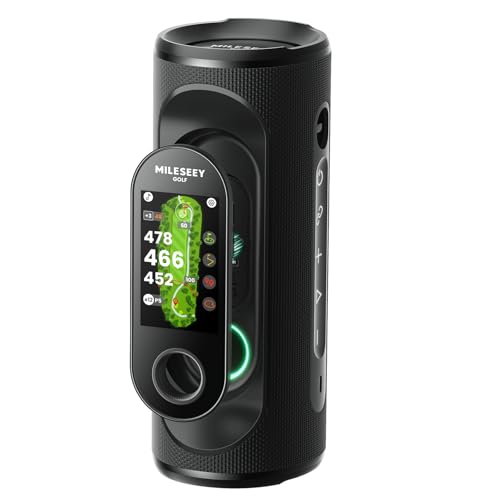
This MiLESEEY unit mixes speaker-style output with a detachable handheld rangefinder, so you get two ways to consume course information. Visual and audible yardages help in carts and on busy tee boxes, and the 15-hour battery specification gives it long-day appeal for golfers who hate mid-round charging.
Compared with the Blue Tees Ringer, the GeneSonic Pro leans harder into audio-guided play and broader utility. The trade-off is obvious, though, because the speaker concept adds bulk and complexity that a plain handheld never has to manage.
Upsides
- Visual and audible yardages suit golfers who prefer hearing distances while still seeing them.
- Detachable rangefinder design gives the unit more flexibility than a fixed-format handheld.
- Layup, front-center-back, and hazard guidance helps with shot planning across different holes.
- 15-hour battery life supports long rounds and tournament days without constant checking.
- IP67 rating adds practical reassurance for wet grass, dust, and cart life.
Small Caveats
- The speaker-plus-handheld concept takes up more room than slimmer GPS units.
- Audio guidance is useful, though some golfers will still prefer silent yardage reads.
- More moving parts mean a little more care during storage and transport.
Details At A Glance
Best Suited To
Golfers who like audio prompts and a more guided round will get the most from it, especially on unfamiliar courses and longer play days.
Where A Sibling Pick Shines
The Garmin Approach G30 suits you better if you want a simpler handheld with less physical bulk and fewer moving parts.
The Blue Tees Ringer sits in a practical middle zone, with a touch screen, magnetic strip, and water-resistant build that fit routine cart days and walking rounds. The 40,000+ course library and 10-plus-hour battery spec give it a broad, workhorse feel without pushing into speaker-style complexity.
Compared with the MiLESEEY GeneSonic Pro, this Blue Tees model is less ambitious and easier to live with. That lighter approach suits you well on regular rounds, though golfers who want audio cues or deeper feature layering may eventually want something busier.
Highlights
- Built-in magnetic strip keeps the unit handy on a cart between shots.
- Touch screen control makes course navigation quick and familiar.
- Water-resistant construction fits damp mornings and imperfect weather.
- 10-plus-hour battery support is practical for full rounds without constant recharging.
- 40,000+ preloaded courses give it strong travel flexibility.
Worth Noting
- The magnetic convenience is useful, though cart placement still matters for security.
- Golfers who want deep stat tracking will find the feature set more restrained.
- The screen size and layout favor quick reads over dense data views.
Core Details
Right Fit For
Golfers who want a straightforward handheld with useful convenience features will appreciate it, especially on mixed cart and walking days.
Look Elsewhere When
The Rad Golf Hand+ is a better match for golfers who want scoring analytics, shot tracking, and more performance logging.
Bushnell’s Phantom 3 Slope keeps the footprint tight at 60 by 76 by 18 mm, which makes it easy to tuck on a cart and forget until you need the next number. Slope technology matters on hilly courses because it adjusts the displayed distance to reflect elevation change, so the reading can be more useful than a flat yardage alone.
The magnetic cart mount is the practical part that ties the package together. Compared with the Blue Tees Ringer, this Bushnell leans more toward compact cart convenience and less toward broader feature layering, so it suits golfers who want a very tidy setup.
Best Bits
- Slope technology helps account for uphill and downhill shots.
- Compact dimensions make it easy to carry and mount.
- Touchscreen control keeps the interface direct and familiar.
- Magnetic cart mount is useful for golfers who stay on the cart most of the round.
Room For Improvement
- The small footprint is handy, though it leaves less room for expansive on-screen detail.
- Cart-focused mounting may matter less to walkers.
- A compact touchscreen unit rewards careful pocket or bag storage to keep the face clean.
Technical Sheet
Made For
Golfers who ride in a cart and want a compact slope-capable unit will find it especially sensible for course days with frequent elevation changes.
Swap It Out When
The TecTecTec ULT-G makes more sense for walkers who want a lighter handheld without the cart-first emphasis.
The Player Pro is the most ambitious Blue Tees entry here, pairing a GPS speaker design with visual, audible, and hazard distance guidance. AI-powered course output is the main attraction, and the 10-plus-hour battery plus magnetic mount make it practical for long rounds and cart use.
Compared with the older Blue Tees Ringer, this version pushes harder into hands-free guidance and broader course interaction. That added convenience feels meaningful on busy tees or in carts, though it also means more complexity than a simple handheld can ever justify.
Reasons To Buy
- Visual, audible, and hazard distances give you multiple ways to take in course data.
- AI-powered speaker concept suits golfers who like a guided setup.
- Magnetic mount keeps the unit easy to place on a cart.
- 10-plus-hour battery life works for full-day golf outings.
- IP67 waterproofing adds useful protection around wet fairways and heavy dew.
Areas To Watch
- The speaker format takes more space than a pocketable handheld.
- Hands-free guidance is helpful, though some golfers still prefer a silent screen-first unit.
- More features usually mean more setup choices and a little more learning up front.
Feature Card
Who Should Grab It
Golfers who want hands-free guidance and a more connected course companion will get the most from it, especially on carts and unfamiliar layouts.
A Better Fit Elsewhere
The Garmin Approach G30 is the calmer choice for golfers who want a compact touchscreen handheld without speaker hardware.
TecTecTec keeps this unit light, simple, and easy to carry, which is exactly the point for golfers who want less bulk in the pocket or bag. The LCD display and rechargeable battery make it feel stripped back in a useful way, not a bare way, and the 38K-course preload gives it enough reach for broad play.
Compared with the busier Rad Golf Hand+ and the speaker-heavy Blue Tees options, the ULT-G feels easier to learn and easier to live with. The honest trade-off is that it skips the richer analytics and audio features, so it suits straight-to-the-point rounds rather than stat projects.
Bright Spots
- Ultra-light body is easy to carry through an entire round.
- LCD display keeps course reads straightforward and familiar.
- Rechargeable battery removes the routine of swapping disposables.
- Preloaded worldwide course coverage gives it broad travel usefulness.
- Simple layout works well for golfers who want a plain, direct tool.
Worth Noting
- The stripped-back feature set leaves out richer performance tracking.
- Golfers who like stronger visuals may prefer a color touchscreen unit.
- Lightweight gear is easy to carry, though it still deserves careful bag storage.
At A Glance
Whose Shelf It Belongs On
Minimalist golfers and walkers who want a low-fuss handheld will appreciate it most, especially on regular rounds where quick reads are enough.
Consider Something Else When
The Hand+ makes more sense for golfers who want shot tracking, club notes, and a deeper performance record.
Arccos takes a different route from the handheld GPS units above, using smart sensors and a Link Pro module to build shot data around your clubs. That makes it useful for golfers who care about shot mapping and season-long patterns more than a screen full of yardage pages.
Compared with the TecTecTec ULT-G, this bundle asks for more setup and a stronger interest in data capture. The upside is a far more detailed view of how you play, though the trade-off is that it’s not the simplest carry-and-go option in the group.
Positives
- Sensor-based shot logging gives you a more automated way to build round data.
- Link Pro support ties the system together for golfers who want structured tracking.
- The bundle format helps you start with the needed pieces in one package.
- Useful for golfers who want to understand club usage over time.
Softer Spots
- This is less of a classic handheld GPS and more of a data system, so expectations matter.
- Setup and attachment take more attention than a simple yardage device.
- Golfers who only want quick yardage reads may find the bundle more involved than necessary.
Core Details
The Right Fit
Data-minded golfers who want a club and shot tracking system will get the most value from it, especially over a full season of play.
Where A Sibling Pick Shines
The Blue Tees Ringer suits you better if you want a conventional handheld GPS with magnetic convenience and less setup friction.
How To Choose The Right Handheld Golf Gps Units
Start With The Way You Play
Course style matters more than raw feature count. A golfer who rides in a cart often benefits from magnetic mounting, a larger screen, or audio prompts, while a walker usually values lighter weight and simpler controls.
That difference shows up fast in daily use, especially during long rounds with frequent club changes. A compact touchscreen unit like the Garmin Approach G30 keeps things lean, while speaker-style models such as the Blue Tees Player Pro trade simplicity for hands-free guidance.
Match The Data To Your Habits
Not every handheld needs shot tracking, fairway logs, or greens-in-regulation counts. Those extras help golfers who study patterns and want feedback after the round, but they also add setup and menu depth.
For straight yardage and hazard reads, a more focused model is usually easier to live with. The Rad Golf Hand+ makes sense when score-tracking matters, while the TecTecTec ULT-G suits you better when plain distance info is enough.
Check Battery, Mounting, And Durability
Battery life affects how relaxed the unit feels on a full day out. Ten-plus-hour and 15-hour claims matter on longer rounds, practice sessions, and tournament days, and they reduce the need to think about charging between uses.
Mounting style matters too, because a magnetic strip or cart mount changes how often you reach for the unit. Water resistance, dust resistance, and sturdy housing are useful in damp conditions, but the trade-off is usually size or cost.
Think About Screen Style And Readability
Color touchscreens are easier to parse at a glance, especially for golfers who like visual maps and pin-position tools. LCD units keep things simple and can feel less distracting, though they usually offer less visual richness.
That makes screen choice a matter of use style, not status. The Bushnell Phantom 3 Slope fits a compact cart-first setup, while the Blue Tees Ringer lands in the middle with a touch screen and practical layout.
A Quick Reality Check Before You Choose
Common Shopping Slip Ups
A frequent mistake is chasing features you won’t use. Shot tracking, audible guidance, and app syncing sound appealing, but they add friction for golfers who only need yardage and hazard reads.
Another slip is ignoring how the unit will live in your bag or cart. A bulky speaker-style model can feel awkward for walkers, while a tiny screen may frustrate golfers who want fast visual checks.
What The Higher Tier Buys
Higher-priced units usually pay for broader course coverage, better interfaces, stronger mounting options, and more ways to consume information. That can mean color displays, audio prompts, deeper stat logs, or tougher housing for wet rounds.
The upgrade makes sense for golfers who play often, travel, or want post-round data. For casual rounds, a simpler handheld often covers the same yardage job with less fuss.
Frequently Asked Questions
Do handheld golf GPS units replace a rangefinder?
They serve a similar purpose, but they present distance data differently. A handheld GPS unit usually gives you broader course context, while a laser rangefinder is more target-specific.
Are touchscreens better than button controls?
Touchscreens feel faster for many golfers because they mirror the way people use phones. Button controls can still be easier in wet conditions or with gloves.
Do magnetic mounts matter?
They matter most for cart riders who want the unit close at hand. A magnetic mount also helps keep the device visible instead of buried in a pocket.
Is course coverage important?
Yes, especially for golfers who travel or play multiple home courses. A larger course library reduces the chance of running into support gaps away from your usual layout.
Are speaker-style GPS units worth the extra bulk?
They are worth it for golfers who like audio guidance and hands-free reads. If you prefer a lighter profile, a standard handheld usually makes more sense.
Closing Thoughts
Your best handheld golf GPS unit depends on how much detail you want during a round and how much gear you want to carry. The Garmin Approach G30 keeps things simple, the Rad Golf Hand+ leans hard into stats, and the Blue Tees models bring stronger convenience for cart use. TecTecTec stays easygoing, while Arccos serves the golfer who wants a deeper record of every round. Choose the shape that fits your game, and the rest gets easier hole by hole.


