


In golf, ball contact and control are everything. When you improve these aspects, you not only lower your scores but also enhance your enjoyment of the game. Here’s why it matters:
Better accuracy in wedge play boosts your distance control.
Improved ball contact helps you hit more greens in regulation, a key predictor of better scores.
Consistency in your swing can turn potential doubles into bogeys, keeping your game on track.
To enhance your game, consider incorporating some Golf Iron Swing Tips. Focusing on your grip, stance, swing mechanics, and practice drills can make a world of difference in your performance.
Key Takeaways
Focus on grip pressure. A relaxed grip enhances clubhead speed and accuracy.
Position the ball correctly in your stance. This improves contact and shot trajectory.
Maintain proper hand positioning. It helps square the clubface at impact for better control.
Practice regularly with specific drills. Consistent practice leads to noticeable improvements.
Emphasize your follow-through. A smooth follow-through promotes balance and shot accuracy.
Grip Tips
Grip Pressure
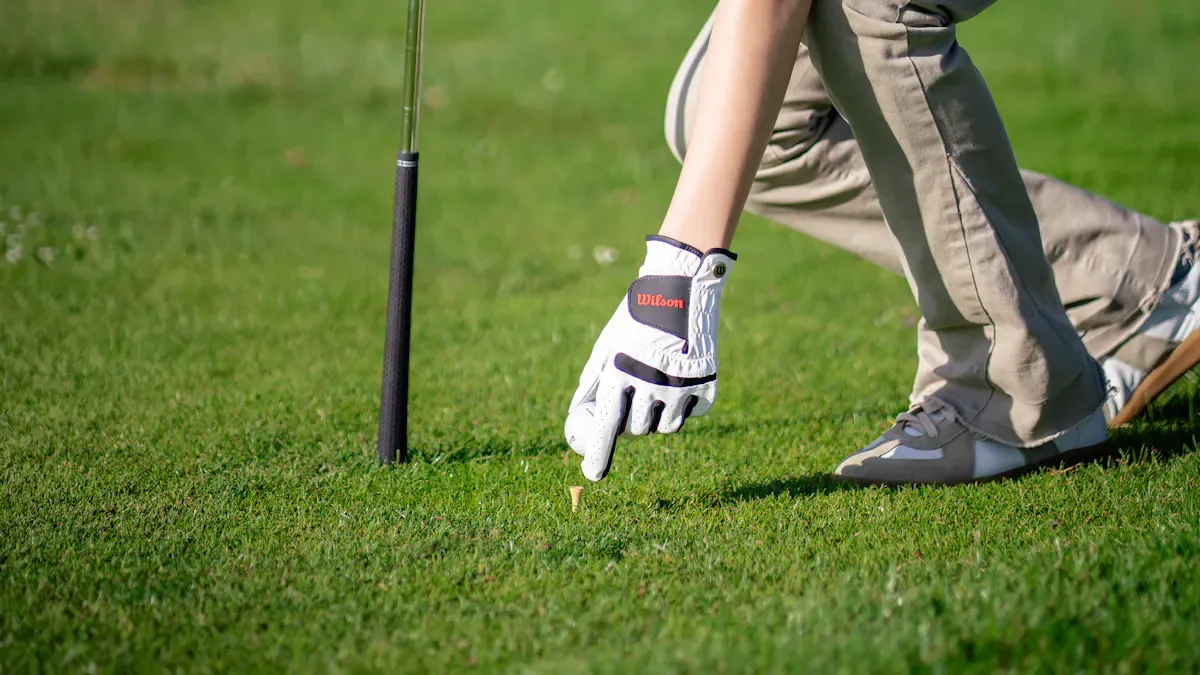
Getting your grip pressure right is crucial for your golf swing. If you grip the club too tightly, you might restrict your swing and lose control. A relaxed grip allows for better clubhead speed and accuracy. Here’s what you need to know:
A tight grip can reduce clubhead speed and lead to inconsistent shots.
Excessive grip pressure creates negative hand torque, which can throw off your swing path.
Aim for a grip pressure that feels comfortable yet secure. Many golfers find that a grip pressure of around 55 to 220 pounds works best, depending on their swing style.
Tip: Think of your grip as holding a tube of toothpaste. You want to hold it firmly enough to keep it from slipping, but not so tight that you squeeze out the contents!
Hand Positioning
Proper hand positioning on the club can significantly enhance your control and consistency. Here’s how to position your hands for optimal performance:
Start by getting into your golf posture without gripping the club. Let your arms hang naturally to find your hand alignment.
Grip the club with your left hand, ensuring the back of your hand points between the target and straight out.
For your right hand, align the palm parallel to the clubface while maintaining the left hand’s grip.
Using technologies like Golf Pride’s ALIGN can help you find the perfect grip. This feature guides your fingers to their ideal positions, promoting consistent hand placement. When your hands are positioned correctly, the clubface squares at impact, leading to better ball contact.
Improper hand positioning can lead to mishits. For example, if you grip the club with your left hand in its normal position but place your right hand lower on the grip, you create a gap. This split-grip setup exaggerates the feeling of the clubhead lagging behind your hands, which is essential for maintaining control through impact.
Remember: Proper hand positioning allows the clubface to square at impact, which leads to flush contact with the ball. This technique enhances the relationship between your hands and the clubhead during the swing.
Common Grip Mistakes
Many amateur golfers make grip mistakes that negatively affect their ball contact. Here are a few to watch out for:
A weak grip can lead to a slice, a common issue among golfers.
Incorrect positioning of the lead hand can cause the clubface to open during the swing.
Rotating the lead hand away from the target can help maintain a square clubface at impact.
By focusing on grip pressure and hand positioning, you can significantly improve your control and ball contact in golf.
Stance and Ball Position

Ball Positioning
Getting your ball position right is key to making solid contact with your iron shots. The ideal position varies depending on the type of iron you’re using. Here’s a quick guide:
Type of Iron | Ball Position |
|---|---|
Long Irons | Center to slightly forward |
Mid Irons | Center |
Short Irons | Center |
When you center your ball position, you set yourself up for success. If you place the ball too far back, you risk a shallow angle of attack. This can lead to poor contact and reduced ball compression. On the other hand, positioning the ball too far forward can create a higher launch angle with excessive spin, which diminishes both distance and accuracy.
To achieve optimal results, position the ball slightly forward of center in your stance. This encourages a descending blow, enhancing compression and control over your shot’s trajectory. Focus on maintaining a consistent ball position to improve your ball striking and accuracy.
Feet Alignment
Your feet alignment plays a crucial role in your swing mechanics. Position your feet shoulder-width apart and align your body parallel to the target line. This setup helps maintain balance and ensures a straight swing path, which is vital for accuracy in your iron shots.
For a balanced stance, keep your knees flexed and distribute your weight evenly on both feet. A slight hip tilt can help keep your upper body in position for an effective strike. Remember, the optimal stance width for full swings, including irons, should not exceed shoulder width. This width enhances rotary force, leading to increased clubhead speed and improved stability.
By focusing on your stance and ball position, you can significantly improve your low point control and overall performance on the course.
Swing Tips
Backswing Essentials
Your backswing sets the stage for a successful shot. To improve your swing and achieve better ball contact, focus on these key elements:
Keep your nose over the ball throughout the backswing. This helps maintain your balance and alignment.
Avoid shifting, sliding, or swaying while turning to the top of your swing. Stability is crucial for consistent contact.
Pivot your right hip inside your right foot to create torque and power. This movement generates the energy needed for a strong downswing.
As you begin your takeaway, involve your lead side. For right-handed golfers, this means turning your left shoulder away from the target and down toward the ball. Continue rotating your upper body until your back faces the target. This adds length and coil to your swing, which is essential for generating clubhead speed.
The length and tempo of your backswing also play a significant role in your swing control. Aim for a swing tempo ratio of 3.0:1, meaning your backswing should take three times longer than your downswing. This consistent timing helps create a repetitive pattern, leading to solid ball contact.
Tip: Practice your backswing with a metronome to develop a rhythm that feels natural. This can help you maintain the ideal timing during your swing.
Follow-Through Importance
Your follow-through is just as important as your backswing. It ensures a complete rotation, which is essential for solid ball contact. A smooth follow-through maintains balance throughout your swing, contributing to a clean and straight shot. Here are some reasons why follow-through matters:
It promotes consistent clubhead speed, leading to better shot accuracy and distance.
A proper follow-through helps you maintain control over your swing path, reducing the chances of mishits.
Professional golfers emphasize the importance of follow-through for maximizing control and distance. They often describe it as a way to carry momentum past the point of impact.
To achieve an effective follow-through, focus on these aspects:
Set initial and end points of your swing. This helps you visualize the entire motion.
Allow momentum and inertia to carry your swing past impact. This creates a fluid motion that enhances your overall performance.
Maintain a steady head throughout the swing. This stability helps you keep your eye on the ball, ensuring better contact.
By mastering your swing mechanics, including both the backswing and follow-through, you can significantly improve your golf swing control and overall performance on the course.
Practice Drills
Contact Drills
Improving your ball contact is essential for flush iron shots. Here are some effective drills to help you achieve that:
Drill Name | Description |
|---|---|
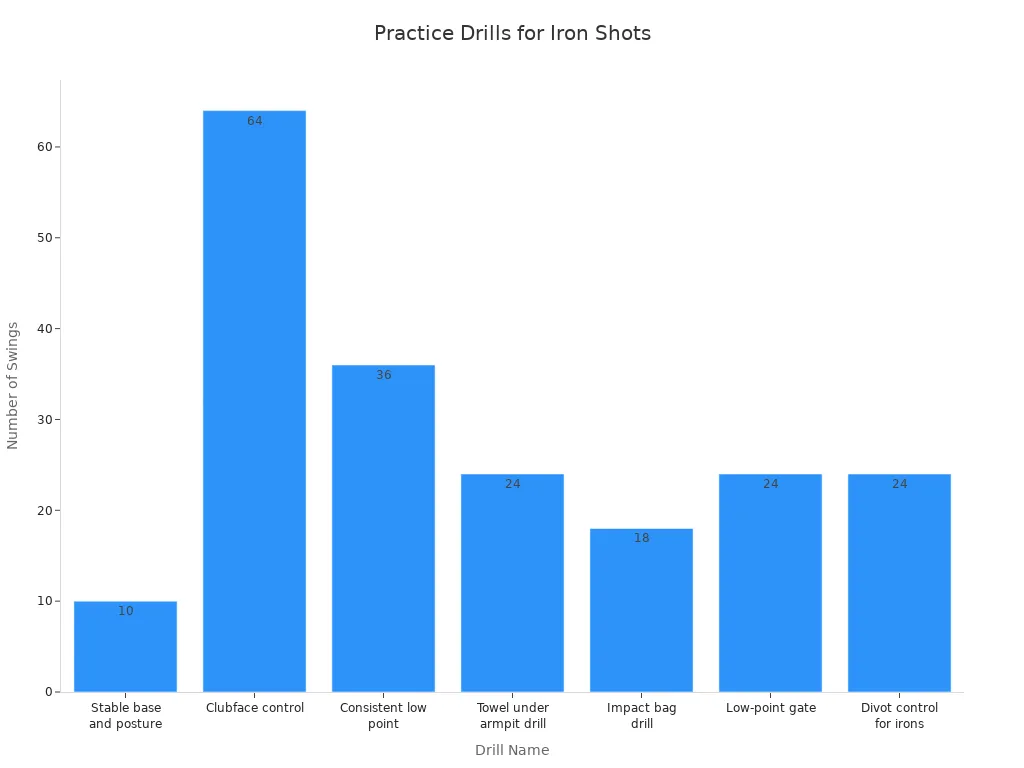
Stable base and posture | Use a mirror or video to check your spine angle and knee flex. Hold your posture for 1 minute, then do 10 short swings. |
Clubface control | Place a target outside the ball line. Swing to keep the leading edge square at impact, doing 5 sets of 8 swings. |
Consistent low point | Set a tee behind the ball. Ensure the tee remains intact after a good strike, doing 6 sets of 6 swings. |
Towel under armpit drill | Keep a towel in place during swings to promote connection. Do 3 sets of 8 swings at 60-70% club speed. |
Impact bag drill | Focus on square face and compressing the bag. Do 3 sets of 6 swings with an audible thud. |
Low-point gate | Place two tees 3 inches apart in front of the ball. Swing through without hitting the tees, doing 4 sets of 6 swings. |
Divot control for irons | Swing to take a divot starting 2 inches after the ball. Do 4 sets of 6 swings. |
To see measurable improvement in your ball striking, practice these drills three times a week. Aim for 50-70 focused swings per session. With consistent feedback, you can expect noticeable improvements in just 2-4 weeks.
Control Drills
Control drills help you refine your swing mechanics and improve ball striking. Here are some drills to consider:
Drill Name | Focus Area | Description |
|---|---|---|
Target Practice Drill | Distance Control | Set up targets at varying distances to improve your distance judgment and swing control. |
One-Handed Drill | Swing Mechanics | Swing with one hand to emphasize proper mechanics and control. |
Stair Drill | Consistency | Hit several balls in succession to enhance consistency in shots. |
Gate Drill | Swing Path | Use alignment sticks to create a gate for your club to ensure correct swing path. |
Tee Drill | Consistency | Strike a tee placed in the ground to focus on swing accuracy. |
Mirror Drill | Swing Path | Use a mirror for immediate feedback on body movements during the swing. |
By incorporating these drills into your practice routine, you can significantly improve your swing consistency and overall performance on the course. Remember, practice improving your game is key to achieving lower scores!
Improving your golf iron swing takes dedication, but the rewards are worth it! Here’s a quick recap of what you learned:
Grip and Hand Position: A proper grip connects you to the clubface, enhancing control.
Stance and Ball Position: Aligning your body and ball correctly sets you up for success.
Swing Mechanics: Focus on your backswing and follow-through for better contact.
Practice Drills: Regular practice with purpose leads to faster improvements.
Remember, consistent practice is key. Techniques like visualization and setting clear goals can keep you motivated. You might notice progress in a few months, but achieving true consistency often takes a year or more. So, stay patient and keep swinging!
Tip: Celebrate small victories along the way. They’ll fuel your motivation and help you enjoy the journey!
FAQ
What is the best grip for my golf iron?
The best grip for your golf iron is one that feels comfortable yet secure. Aim for a neutral grip where your hands are positioned correctly, allowing the clubface to square at impact for better control.
How should I position the ball in my stance?
Position the ball slightly forward of center for long irons, centered for mid-irons, and slightly back for short irons. This helps you achieve a descending blow, improving contact and trajectory.
Why is my follow-through important?
Your follow-through is crucial for maintaining balance and ensuring a smooth swing. A good follow-through promotes consistent clubhead speed, leading to better accuracy and distance on your shots.
How often should I practice these drills?
Aim to practice your drills three times a week. Focus on 50-70 swings per session to see noticeable improvements in your ball contact and overall performance within a few weeks.
Can I improve my swing without a coach?
Yes, you can improve your swing through self-practice and drills. Use video analysis or mirrors for feedback. However, consider occasional lessons with a coach for personalized guidance and tips.


